
CXCR2 inhibitor design: three new chemotypes for a target with validated senescence biology
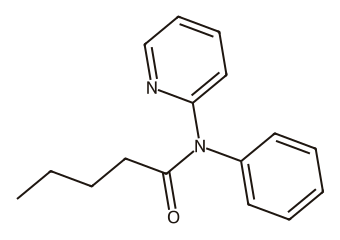 Our candidate
CXCR2 is one of the best-validated senescence targets in the literature, and it has no modern chemistry aimed at ageing. We designed three candidates against it, each with a two-step synthesis route using named reagents and a written protocol at 10 mg scale. This is the reasoning behind that, including why a drug class with three clinical failures behind it was still worth designing for.
Why CXCR2 is on our list at all
In 2008, Acosta and colleagues showed that chemokine signalling through CXCR2 reinforces cellular senescence. Knocking the receptor down relieved both replicative senescence and the oncogene-induced kind, and it reduced the DNA damage response that accompanies them. Pushing CXCR2 expression up did the opposite and drove cells into premature senescence through a p53-dependent route.
That is a clean piece of causal biology, published in Cell, and it has held up. Senescent cells secrete a mixture of inflammatory signals known as the senescence-associated secretory phenotype, and several of those signals are CXCR2 ligands. The receptor sits inside a feedback loop that keeps senescent cells senescent and inflames the tissue around them.
A drug that interrupts that loop without killing the cell is called a senomorphic. It is a different strategy from senolytics, which clear senescent cells outright, and it suits tissues where you cannot afford to lose cells.
What actually happened in the clinic
Every CXCR2 antagonist that reached patients went into a respiratory indication, mostly chronic obstructive pulmonary disease and asthma, on the reasoning that neutrophil recruitment drives the pathology. The results were poor and in one case worse than poor.
- Danirixin failed its phase 2b trial in COPD with chronic mucus hypersecretion. No dose improved symptom or health-status scores against placebo. Worse, exacerbations were more frequent in the treated groups, and pneumonia was more common at the 50 mg dose. That is a safety signal, not just a miss.
- Navarixin is the most studied compound of the class, tested across COPD, asthma, psoriasis and several cancers. Development was discontinued after modest and narrow results.
- AZD5069 went into asthma, bronchiectasis and COPD. The asthma trial concluded that CXCR2 antagonists do not offer an effective option for uncontrolled persistent asthma.
The pattern is consistent enough to be informative. Blocking neutrophil recruitment in an inflamed lung did not help the patients, and in the danirixin trial it plausibly hurt them, which fits a receptor whose job includes host defence.
Why that record does not settle the ageing question
Those trials tested a specific hypothesis: that neutrophilic inflammation drives COPD and asthma, and that reducing it improves lung function and symptoms. That hypothesis failed.
The senescence hypothesis is a different one. It says CXCR2 signalling maintains a senescent state and its inflammatory output in ageing tissue, and that damping the loop reduces the burden those cells impose. The endpoint is different, the tissue is different, the timescale is different, and the dosing regimen a chronic ageing indication would need looks nothing like a COPD trial.
Where the chemistry sits, measured
We designed candidates against CXCR2 through our reaction-first engine, which means each one arrives with a synthesis route rather than a structure alone. The obvious question is whether they are just the failed drugs redrawn.
We measured it, using Tanimoto similarity on Morgan fingerprints. First, how similar the four clinical compounds are to each other. Then, how similar our candidates are to the nearest of them.
Read that carefully, because the honest reading is narrower than the flattering one. Our molecules are further from the clinical compounds than those compounds are from each other. They are new chemotypes rather than analogues.
What that does not mean is that being different is an advantage. Distance from a failed drug is not evidence of working. It only means the specific liabilities of that chemical series are not automatically inherited, which is a modest and real thing to be able to say.
What we have, and what we do not
Three candidates, each with a two-step route using named reagents, a predicted ADMET profile, a genotoxicity screen run over the reagents rather than only the product, and a stated distance from the region where our models are reliable.
One of them appeared in a make-on-demand catalogue at roughly 190 US dollars for 10 mg, on a stated 30-day lead time to India, when we checked in August 2026. That is a fact about a supplier listing on one date. It is not a claim about the molecule, and confirming that anything is actually in stock needs a supplier account we do not hold.
There is no assay data. No cell work, no animal work, nothing. They are computational hypotheses with routes attached, which is precisely what our engine produces and the limit of what it can honestly offer. The value is that a chemist can order the starting materials and test the hypothesis in weeks rather than arguing about whether the structure is makeable.
The general point about failed targets
CXCR2 is one instance of a pattern worth naming. A target accumulates strong mechanistic evidence in one disease area, a drug class gets built, the trials fail, and the target acquires a reputation. The reputation then travels to indications the trials never tested.
Sometimes the reputation is deserved and the biology was wrong. Sometimes the compound, the dose, the patient population or the endpoint was wrong and the biology is fine. Telling those apart requires reading what the trials actually measured, which is slower than reading the conclusion and cheaper than repeating the mistake.
Our target set is split into two programmes for a related reason: the genes with lifespan evidence and the genes with rejuvenation evidence are almost disjoint, which we measured rather than assumed. That separation is written up in the lifespan versus rejuvenation post. How a candidate gets assembled with its route intact is in synthesizability by construction, and the full pipeline is documented in Methods.
Every figure here comes from a run on our own engine, and the measurement scripts sit in the repository beside the code they measure. Where a result is null, weak, or inconclusive we say so and publish the interval. Full detail is on the benchmarks page, and the design pipeline is written up in Methods. Source is available for audit on request.