
01
Biology in context
Lifespan and rejuvenation research, clearly distinguished. Tissue and hallmark context travels with the design.
DE NOVO DRUG DESIGN FOR AGE-RELATED DISEASE
Pick an ageing protein, a tissue, and the kind of age-related damage. In a few minutes you get up to 12 brand-new candidate molecules — each with a proposed synthesis route, the age-related disease it addresses, and the endpoint it would be filed against. 3 design runs a month, free.
Work email verification. Research use only.
01 / A DIFFERENT STARTING POINT
A target is only part of the story. Explore it alongside tissue context and aging biology—then see the chemistry, the trade-offs, and the evidence in one place.
Lifespan and rejuvenation research, clearly distinguished. Tissue and hallmark context travels with the design.
Every candidate is built from chemical building blocks and reactions. Review a proposed synthesis route alongside each delivered candidate.
See where a prediction leaves familiar chemistry. Inspect uncertainty instead of mistaking a high score for proof.
THE LIVING ATLAS / EXPLORE, DON'T JUST SCROLL
Two lenses. One research question. Explore the body and the hallmarks of aging, then bring your chosen context into molecular design.
 Schematic tissue map · not an anatomical model
WHERE YOU ARE LOOKING
Metabolism & clearance
Review predicted liver injury and drug interactions. Tissue intent does not establish liver selectivity.
Does a molecular change reflect better cell function, rather than only a change in a clock readout?
Your selections are research lenses, not evidence of a causal tissue–hallmark interaction. No prediction or design job is run here. Hallmarks follow López-Otín et al., Cell (2023).
NOW, WHERE IT LANDS
Pick a tissue. You get a molecule, with its synthesis route, that addresses a mechanism implicated in a named disease, judged on a real regulatory endpoint.
315 of 315 target and tissue pairings come back with a disease and an endpoint, across 55 age-related diseases and 11 body systems.
Could it be approved? See who already did itTHE MAP OF YOUR FIELD
Every disease is grouped the way a clinician reads it. Choose a tissue and watch it light up across the body systems it touches.
Liver shows up in 3 diseases across 1 body system.
Pick any target and any tissue: all 315 pairings come back with a disease and an endpoint.
Create your free accountTHIS PATH IS WALKED
You are not betting on a new target. You are betting on new chemistry against a protein that already has an approved medicine, made by another company and on the record with a date. We start a fresh molecule from there.
Another company's medicine. FDA-approved Apr 2016 against BCL-2.
Venetoclax (Venclexta) — FDA-approved against this exact protein since 2016.
A molecule designed from scratch against the same protein, with its own synthesis route and its own evidence.
BUT HOW DO YOU KNOW IT BINDS?
A score on brand-new chemistry is a confident number from outside its own evidence. So every candidate can arrive with a sibling on the same route, one building block apart, that sits nearer to known binders.
126 of 176 delivered molecules carry a sibling, and because it shares the route it is makeable, not hypothetical.
Every number we show says where it stops. When a similarity reading sits outside the range it was measured on, we tell you, instead of printing a confident score.
Every candidate addresses a mechanism implicated in a named disease, with the endpoint it would be judged on. That precision is what keeps the path to approval credible.
THE SEARCH LAYER / QUANTUM-INSPIRED, CLASSICALLY COMPUTED
A shared tissue × hallmark representation, with diagnostics kept distinct from measured biology. Select an entry to see its inputs, operation, output and boundary.
Conceptual representation · no job, score or API request runs in this preview.
target-state distance
Compares a 22-component representation with a target-state prior.
Ten tissue ECR components and each molecule’s hallmark-localization profile.
Builds a 22-component representation and compares it with the target-state prior.
A target-state distance for each candidate.
BoundaryThe target weights are priors, not measured efficacy or a predicted treatment effect.
The QX master flag is off unless explicitly set; this explorer is not a set of controls that enables engine flags. QRC decoder reordering requires its own opt-in. No quantum hardware advantage or efficacy result is implied.
02 / FOLLOW YOUR QUESTION
Pick a target to explore a research context. This is a guided product preview, not a generated result or a treatment recommendation.
Investigate a chromatin-associated target at the intersection of lifespan and rejuvenation research.
Activation is a design objective, not a measured property of a generated molecule.
Your research note: Epigenetic alterations. Hallmark selection is context, not an independent generation control.
Use this research context11 lifespan targets and 10 additional rejuvenation targets. SIRT6 bridges both research areas; their scores are not interchangeable.
03 / FROM QUESTION TO CANDIDATE
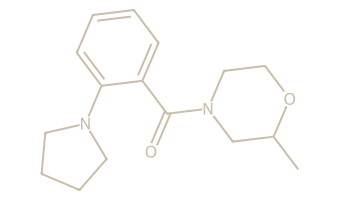
Example structure · not experimentally validated
Review molecular structures, physicochemical properties and similarity to reference compounds. Export candidates for your own analysis.
04 / SCIENCE WITHOUT THE FINE-PRINT TRAP
Novel chemistry is precisely where predictions become less reliable. We show that boundary—not just the most flattering benchmark.
Read the full evidencePerformance falls on unfamiliar chemistry. Treat predictions as hypotheses for testing, not experimental measurements.
Longevity efficacy is not established. External lifespan tests did not demonstrate ranking ability: mouse ITP AUC 0.645, 95% CI [0.447, 0.826]; worm MMC correlation −0.023 (p = 0.796). These limitations remain visible in the full benchmark.
YOUR NEXT QUESTION STARTS HERE
Not a waitlist — the platform runs today. Create an account now and your free runs carry straight through launch.
Create your free accountWork or institutional email. No credit card.
Need longer or more capacity? Talk to us about an extension
Candidate yield depends on chemistry and safety filters. Personal email addresses require review. Accounts created before launch keep their free runs; existing results stay available. View access details.
3 months of access, 3 design runs each month, and up to 12 candidates per run. Explore all 21 runnable targets, inspect results and export your candidates. Safety and chemistry filters may return fewer candidates, including none.
No. GeroQubit is a product you can use directly. Register with your work or institutional email and verify it to activate self-serve access. Personal email addresses go through manual review. No credit card is required.
Nothing you have is taken away. Accounts created before launch keep their free runs, and existing results remain available. Paid tiers arrive at launch; nothing converts to a paid subscription automatically, and we will not bill an account that has not asked to be billed.
No. These are computationally designed research candidates. Predicted binding, safety and aging-related signals require independent synthesis and experimental testing. GeroQubit does not provide medical advice or compounds for human use.