
GQ-259 , end to end.
One real candidate, exactly as the platform produced it, target and tissue scope, hallmark localization, per-tissue phenotype, ADMET, a verified two-step route, and an honest account of what it is and isn’t.
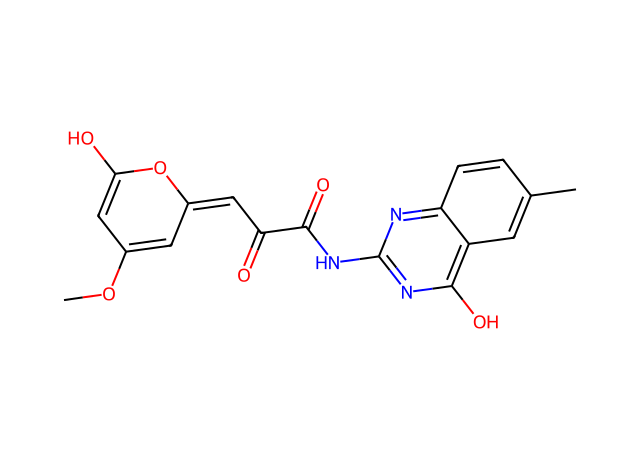
This run predates two scoring corrections, both of which lowered published numbers. Its stored composite (1.00) was normalised to its own batch, so we show ≤ 0.54, a ceiling derived from the axes below.
Pharmacophore 0.98 is pre-correction, indicative only. Structure, route and ADMET are unaffected.
A nutrient-sensing / autophagy senomorphic.
The aging-signature readout.
A mechanistic structural prior, disclosed, not a lifespan claim (see the methods note). It tells you where the candidate is predicted to move the aging signature.
Relative, within this candidate -- not a claim that any tissue gets younger. The thymus row is greyed because its clock is built from the immune clock by hand and contains no thymus measurement; it is shown rather than hidden so the ranking is not quietly reordered to flatter us, but it is not evidence.
A two-step route, because it was built from reactions, not guessed.
Each atom is traced to its origin synthon, so the route is true attribution from the recipe, not post-hoc explanation. Building blocks here are drawn from the design library; for a live program we map candidates to in-stock catalogue building blocks before hand-off.
- Novel chemotype: similarity to known geroprotectors is low (≈0.15), a freedom-to-operate signal, not a red flag, but it also means there is no close precedent.
- The phenotype and clock-reversal figures are mechanistic priors, disclosed, not validated against lifespan.
- This molecule comes from an earlier run that predates our binding-plausibility and lifespan-prior scoring, so those are not reported here; a re-score would populate them.
- GQ-259 is a computational hypothesis for medicinal chemistry, not an approval-ready compound. It requires synthesis and wet-lab validation.